Friday, May 7, 2010

Tree planting and another bird for me.

Today I went up near Barrie to participate in a tree planting. The idea in short is that it is to improve habitat, help reduce erosion and nutrient loading as well as help with water retention in the watershed for the Innisfil creeks system. There were fifty students and about fourteen others helping with the planting. We were planting dogwood, silver maple, pine, cedar, and tamarack seedlings all along the edge of a creek that cut through two properties. I only stayed until just after noon but in that time I managed to plant one hundred trees.

It was nice to be out enjoying/helping nature but it was a little different this time due to some very interesting contrast. For example one student was naming each tree that they planted and the one name I heard was Napalm. Another student was yelling at a red-winged blackbird and threatening to throw their shovel at it. The other funny part was almost the whole time I was out planting there was a homeowner nearby running his electric saw cutting up branches. Circle of life I guess.

Now as for the other new bird, I left early and decided to slowly drive along this canal and it was very rewarding. I caught a glimpse of a bird like image that made me stop for a closer look. It kind of looked like a mallard standing on a log but I couldn't see a head. Once I zoomed in on it I realized right away that it was a black-crowned night heron. It was bigger than I imagined. It was much more tolerant of my presence than the great blue herons that I see. Usually they fly pretty quickly. Anyway, I watched it for a while but other than a quick drink of water it just looked like it was resting so I left it alone and went on my merry way quite happy with being able to see one more new bird. The lighting wasn't ideal for pictures but I snapped a few for my extended memories. I also saw there a kingfisher, mallards, canada geese, a muskrat, killdeer, greater yellow-legs sandpiper, lots of wood ducks and barn swallows. There was also what I think might have been a solitary or pectoral sandpiper but it was a bit far and lighting wasn't the best for identification. Both of those would have been new birds for me too but since I am not sure of the species I will leave this one out. Plus I plan on doing a shorebird trip soon that hopefully will produce both of these species of shorebirds.


Friday, April 30, 2010

One more for the list.

Today started really early because I couldn't sleep so I got out of bed at 4 am to start my adventuring. The weather is calling for rain again on Saturday and Sunday so once again I ended up trying to cram a lot into Friday. I met up with a friend and we went down to this area to look for the common moorhen. They say they are common but I have not seen one until today. It was a much easier search than I expected because as soon as I came up on the pond I saw it foraging along the edge of the water. What an interesting looking bird. When I showed my girlfriend the pictures she said "It looks like it has that Halloween candy called candy corn on it's face and it has matching legs". We watched that for a while then explored a few other areas with no luck so we went our separate ways. As soon as we did, my friend discovered a few ponds filled with waterfowl and I stumbled on a few vultures and groundhogs that were not shy at all. I even saw a horned lark on the side of the road that had a beak full of bugs. It was such a good day, I ended my searching early and came home to get some stuff done around the house. I hope tomorrow morning it doesn't rain for a while so I can do some more exploring.


Tuesday, April 27, 2010

Horned Grebe Status

Okay, so I was doing some research and I found out that the Horned Grebe is actually a species of concern in Ontario. I read that its numbers seem to be declining and they are unsure why but most likely it has to do with habitat loss. It also requested for any sightings to be reported to the MNR. I went and filled out an online Rare Species Reporting Form which was actually quite detailed. A lot of the questions I didn’t have the answers to but I gave all the information that I had and included a picture of the bird so they would be able to confirm the identification.

It says they are rare breeders in Ontario but the location looked ideal for this bird to set up a nest. They say that they nest usually a meter or two away from the waters edge and since fishermen were walking all over the place oblivious to the needs of this species, I included that in my report. I read someone else comment on a forum recently that just rang true to me. They said “I understand 'conservation' to mean, for the benefit of wildlife primarily, and humans secondarily'.” I think that applies nicely here even if that means less photo opportunities for me.

Sunday, April 25, 2010

Two new birds this weekend and a mutant!

Well it was another great weekend. I spotted this pair of horned grebes on Friday while exploring a new area but I couldn't get any decent pictures so I thought I would try again on Saturday but this time I would try something a little different for me. So I donned the camouflage, found a spot close to where I saw the grebe on the day previous and sat there and waited. The place was crawling with fishermen and in fact one walked right in front of me without seeing me. I said "morning" to him as he passed and all he could say was "Holy" and "Geez". Oops, I think I startled him but it made me feel like my plan would work. As the fisherman made his way to where the grebe was resting, it woke up and started looking for food. It came quite close to me but I still couldn't get any full frame photos because of the area I choose. It was feeding in this little bay and I should have chosen a site closer. Oh well, maybe next time. I also want to find out a way to make the click of my camera quieter. If anyone has any suggestions please let me know.


The next part of my weekend was very interesting. I saw a spotted bird along the edge of a river that I couldn't identify at first glance, so I got out of the car and made my way to an area with a better vantage point. The bird came very close but I was still very confused. It looked a lot like an american robin except for all of the white. It even moved and sounded like a robin. I took a video of it just in case I would need it for identification later even though it was pretty apparent that it was just a mutated robin. When I got home a posted a couple of photos on an online birding forum for some help identifying it. I got a response very quickly which offered up the idea of Leucism. I read the link the person attached and then did some research of my own and it looks like they would call this a leucistic pied amercian robin. This is a rare genetic mutation that prevents melanin from being deposited normally on feathers. Unfortunately for this bird it has some challenges ahead of it. This condition will make it more visible to predators, it might have a harder time getting a mate and it might have a harder time staying warm. So I wish it luck.


The final exciting thing was finding a spotted sandpiper foraging in a river. It was very far away and at this point in the day I was too tired to attempt getting closer for a better photo. Today it is supposed to rain all day so it will be my day of rest.

Thursday, April 22, 2010

Happy Earth Day!!

I like to think of Earth day as one day to learn and put into practice, something that will benefit our planet for 365 days of the year and for many years to come. Here is my list of some of the things I currently do or plan to start doing.


1. I would like to plant a tree. This will help with lowering the amount of CO2 in our atmosphere. Trees breathe in CO2 and exhale oxygen. Not that CO2 is bad, but right now the ratio is way out of whack and we need to get it back to being balanced. As the forests meet our roads there are always baby trees trying to help expand the forest. Municipal workers often clear any growth that is growing to close to the road. So a free option is to dig up one of these seedlings, and plant it somewhere where it can flourish. You can even think of it as saving a tree.

2. I want to find a good phosphorus free detergent. Too many phosphates in our waters lead to algae blooms and plant life growing out of control.
http://www.lcbp.org/Factsht/P-free_detergents.pdf

3. I wash my clothes in cold water. Heating up the water for the laundry really produces a large quantity of CO2 gas and switching from hot to cold water can not only save me money but it can also help heal our planet. This has already become a habit of mine and I will continue this process going forward.

4. Cut out some meat from my menu. Meat production also creates a lot of CO2. If interested check out the chart on this link attached below. I found it very interesting. This one will be heard because I oh so enjoy the classic meat and potatoes type dinner but I will try to make a vegetarian dinner more frequently.
http://timeforchange.org/eat-less-meat-co2-emission-of-food

5. Unplug any appliances in our home that are not in use. As I make my way to bed flipping off the lights, I find all of these little blue, red and green lights hiding all over the place. These items don’t need to be on and I will be making a more conscious effort with turning them off.

6. Turn down the heat in our house and bundle up. Oh yeah long johns, two pairs of socks with slippers and warm sweaters. That is my cozy little heaven right there. We have a programmable thermostat which helps keep the temperature to our desired level and if I start to feel too cold I find a quick run up and down the stairs or a few pull ups on my rock climbing trainer really warms me up fast.

There are many more ideas out there but these are just a few. I personally find that it is hard to stay focused on this stuff but once in the habit, it should be much easier.

Here’s to a greener planet.

Wednesday, April 21, 2010

Sad drive to work.

Today on the way to work I saw a dead red fox, a dead opossum and a dead rabbit that were all hit by vehicles. This is a very frustrating issue that has no easy solution. First let me start by saying I understand that sometimes animals dart out which makes it hard to notice them and very hard to avoid hitting them but with that aside it just seems so inhumane. We plow over these animals and just keep driving. Sometimes with out even checking to see if they are okay or if we could give them help or just some comfort in their last few minutes. We can not even console or help the ones that are left behind and they are just left to fend for themselves.

I would like you to consider for a moment, what would happen if a child wondered on to the street and met the same situation. Would we try harder to avoid the collision? Would we put up a sign indicating children playing or add a crosswalk? What about lawful repercussions like vehicular manslaughter charges or even hit and run? I know it may sound extreme to add these situations to wildlife but why is it that we take human life so seriously when the population of humans is so much higher than some of the wildlife that is struggling to survive right now? If you look at Ontario’s species at risk list, you will find situations like the blanding’s turtles were they travel long distances of around seven kilometers for a mate/food which is causing them to cross our roadways and then in turn they are meeting their demise under the tires of our cars. Or how about the loggerhead shrike with their young foraging for dead bugs along our roadways. They are many more situations like this but now comes the hard part, what are we to do?

Here are a few ideas that I have stumbled upon throughout my travels.

1. Reduce speed limits and have them more strictly enforced and especially around wildlife heavy zones with migratory paths being considered when choosing these zones.

2. When constructing our roadways, add an animal friendly overpass or underpass? They do have a proven track record however it must come with a heavy financial cost. We saw ones similar to this on Vancouver Island last year for the elk.
http://www.wildlifeandroads.org/decisionguide/2_1_6.cfm


3. They also have something called crosswalks for animals. They use software to detect animals on the road, which then triggers flashing lights which then prompts the drivers to slow down. I got to see this first hand last year in Yellowstone National Park for the buffalo.
http://www.azgfd.gov/w_c/StateRoute_260_Elk_Crosswalk.shtml


4. I even found an article that talked about closing the road for a month in both spring and fall due to heavy snake traffic.
http://findarticles.com/p/articles/mi_m0EPG/is_n10_v28/ai_16829054/

I don’t think any one of these ideas will completely eliminate the issue of wildlife being struck by vehicles but if done properly it most likely can help protect some of our species of concern.

I really enjoyed the part in the movie Avatar, where a pack of dogs-like beasts were attacking one of indigenous people and when defending themselves one dog was injured. The female indigenous person put it out of it misery but was sad and frustrated with the unnecessary waste of life. To me the movie displayed a lot of respect for life no matter what kind and I think we as humans could learn to adapt a little more of that into our every day lives.

Safe driving!

Monday, April 19, 2010

The response regarding the status of Canada's polar bears.

I received a response today for the email I sent a while ago which can be read further down on this page. I thought I would share their response with you.

Dear Mr. Smith:


On behalf of the Honourable Jim Prentice, Minister of the Environment, I am responding to your March 16 email message concerning the listing of the polar bear as an endangered or threatened species through the federal Species at Risk Act.

In 2008, the committee on the Status of Endangered Wildlife in Canada, the independent, arm’s-length body that provides advice to the Government of Canada under the federal Species at Risk Act, completed an assessment of the polar bear in Canada as being a species of concern. Prior to listing a species under the Act, extensive consultations with the public are undertaken. Notably, with regard to the polar bear, there are additional requirements for the Species at Risk Act listings consultations, to ensure that the jurisdiction of wildlife management boards under land claims agreements is respected. As such, the listing of the polar bear as a species of special concern on Schedule 1 to the Act is currently undergoing extended consultations with Aboriginal peoples prior to the Minister of the Environment’s decision on listing.

The Governor in Council’s final decision on whether or not to list the polar bear is not expected before the spring of 2011, contingent on consultations with wildlife management boards proceeding in accordance with the current schedule.

While these consultations are under way, Environment Canada is also involved in many efforts to protect polar bears in the Canadian North. In October 2009, Canada signed a Memorandum of Understanding agreeing to work with the governments of Nunavut and Greenland concerning shared polar bears. This memorandum of understanding with Greenland will bring closer co-operation and shared management actions to preserve the Baffin Bay and Kane Basin polar bear populations.

In January 2009, the Minister of the Environment hosted a high-level roundtable meeting with the provinces and territories, wildlife management boards and others who have a management role and a conservation role to protect Canada’s approximately 15,500 polar bears. Since the National Roundtable on the Polar Bear, Environment Canada continues to work with jurisdictions to conserve the polar bear by drafting the above mentioned agreement on managing polar bear subpopulations that are shared between Nunavut and Greenland, consultations on export permitting conditions, and development of National Conservation Strategy.

Further information on polar bears is available on Environment Canada’s Species at Risk Public Registry at http://www.sararegistry.gc.ca/.

I note your comment about climate change. Climate change and air pollution continue to be among the most pressing environmental issues of our time, and it is for this reason that the Government has taken a strong stance on the issue, committing to reduce Canada’s total greenhouse gas emissions by 17 percent from 2005 levels by 2020. For more information on federal actions to address climate change and on how you can make an important difference, please visit http://www.climatechange.gc.ca/, or call 1 800 O-Canada (1-800-622-6232).

I appreciate your concern for polar bears. Please accept my best wishes.

Sincerely,
Cynthia Wright
Acting Assistant Deputy Minister
Environmental Stewardship Branch

Yurting @ Killarney

What an amazing weekend I had and it all started with a glimpse at a couple of deer on the side of the road and then shortly after we discovered a snapping turtle trying to make it across the road so we helped it to the safety. It was very stressful and but rewarding in the end. I even checked on the way home and no turtle remains to be seen so it lived to see another day.


Once we got to the park we were greeted by a large number of yellow-bellied sapsuckers doing what is called territorial drumming. They usually seek out the loudest hollow tree around to peck which lets the other birds know that is their territory but at the park they were using the plastic roof of the outhouse and it was loud. Even though it was a shocking surprise to hear while in the outhouse, it was very neat to see human interaction actually benefiting wildlife for a change.


Later in the day, while out for a walk we got to see some house finches feasting on what little buds were out. Then we went down to a marshy area and heard some frogs singing. It was so loud. I took a video which I have attached it below. It is a little shaky because I didn’t use a tripod but you can hear just how loud it was. It felt a little dirty to be enjoying the sounds of amphibian love.


Saturday came and it was cold. We had some small ice pellets coming down for a while but we still managed to find some nature. In the morning we had a few eastern phoebes come around our site and we saw lots of flickers dancing and chasing each other about. Then later in the day while exploring we saw many different kinds of ducks, a mink and a heron. Later while relaxing by the fire at night we were visited by a fox. It came in quite close, most likely expecting to be fed but once it realized we weren’t going to, it walked around our site and continued its hunt.


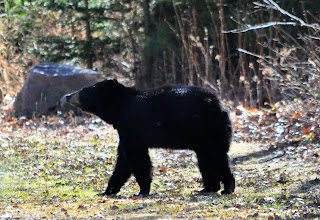
Sunday brought some real nice weather. The day started with a short drive which yielded sightings of a beaver, two sandhill cranes and a hooded merganser. Then while loading up the car, a black bear made an appearance. Once we were mostly packed up we went for a big hike and there we saw a harrier, a pair of wood ducks and a deer. Not much else but it was good exercise. Sadly we heading home but in four more days we will be searching again.


Come on Friday!

Sunday, April 11, 2010

Red Crossbills

Not a lot of time this weekend to be out looking for stuff but I managed to squeeze in a drive and found this colourful pair of birds on the side of the road. At first glance I thought the were grossbecks but upon further inspection I realized it was a pair of red crossbills. The male is red and the female is yellow. What a wierd looking bird, with their crossed mandibles. Apparently it helps them extract the seeds from conifer cones. This is another new bird for me and very exciting to keep seeing new stuff.


Sunday, April 4, 2010

Spring has been unleashed part #2

As soon as I closed the door to my car this morning my first skunk of the year ran down my neighbours front yard. It was still too dark for any good pictures so I just watched as it wandered around for a bit. After it disappeared into the cedars I made my way toward the Holland marsh area. I have heard this area is good but most of the information I have read about here only mentioned stuff being seen in the summer but I thought I would give it a try to see what I could find anyway and it turned out to be really good. I started at canal road where it connects with Hwy 9 and then just followed the canal. I didn't even use the gas, I just let the car idle. The first section was only 2.9 kilometres but it took me almost an hour because I kept seeing stuff and stopping for photos. As soon as I got on the road I found a beaver having a morning bath. Just after that a Red-tailed hawk scoping out the territory. I also got to see many wood ducks, a muskrat, two more beavers and lots of Canada geese, mallards, red winged blackbirds and grackles and finally my first ever Eastern Phoebe. It didn't like to sit still and it liked to keep its distance but it was still really neat to see another new bird for me. Oh, I also stumbled upon a great blue heron that ruffled his feathers for a moment. Not a great shot but it looks kind of funny so I included it. What a good weekend!!


Saturday, April 3, 2010

Spring has been unleashed.


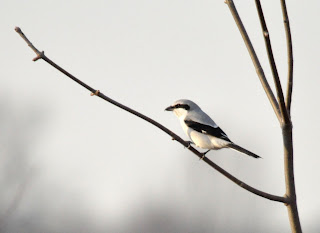
What an amazing weekend so far. Yesterday we headed up to Minesing swamp and when we got there we found that the water had really retracted quite a bit but I think this really helps our views of the waterfowl. There was a lot less water for them to hang out in making it a stronger concentration and bringing them closer to the road. We had much better views of the northern shovelers, pied-billed grebes, hooded mergansers and northern pintails. We also got to see a porcupine wonder around on the road for a while and a very sleepy raccoon that we woke up by mistake. Just on our way out of the area we got to see a shrike hunting along the side of the road. Upon further inspection we are pretty sure this is a loggerhead shrike instead of the more common northern shrike. There are a lot of concerns right now for this bird in Ontario because they say there are only 30 breeding pairs in the whole province. We will be doing a grasslands bird survey this year to help provide them with some information to better assess their populations and distribution.


On Saturday we headed down to the lakefront with hopes of catching a glimpse of the red-necked grebes and possibly the horned grebes that have been mentioned. We ended up seeing hundreds of the red-necked grebes but no horned were to be found. There were also lots of long-tailed ducks and a first for me was a pair of red-breasted mergansers. Both of these guys were calling a lot and fighting over the ladies. It was amazing to hear their sounds. I really like the call of the long-tailed duck. Click here to hear their call. Speaking of sounds, the frogs were out singing in the ponds this weekend and I also got to see the first painted turtles of the year and while uploading some pictures the first mosquito came in the back door and tried to suck my blood. So over all just a great weekend so far although I could have gone longer before seeing a mosquito.


Friday, March 26, 2010

Fun in the sun.

Today started with a nice drive around the Luther Marsh area and even though it was really cold I was able to find a lot of wildlife. It started with some northern shovelers, green-winged teals, american widgeons and some northern pintails. I also spotted a northern shrike and three sandhill cranes. Near the end of my time out this morning I found a field that had three northern harriers in it. There were two females and one first year male. This was a new area for me and it is very exciting to learn another location where these guys live.

Later in the afternoon we decided to head up to Collingwood to see what we could find and along the way we found three wood ducks (two males and one female) in the river at Horning Mills. Once we got to Collingwood we went down to the harbor and there we ending up finding a type of seagull that we have never seen before. Other than the obvious size differences in the species, there are a few other clues to look for to help tell these guys apart. In the picture I took I captured not only the new species up front but I placed a more commonly known ring-billed gull in the background for comparison. The picture is of a Thayer's Gull and you can see they have pink legs and feet instead of yellow and these guys have brown eyes instead of yellow. This gull is a rare visitor from October to May. I have never really looked for differences in gulls so it was neat to find out the different types.


Wednesday, March 24, 2010

Welcome back meadowlarks!!

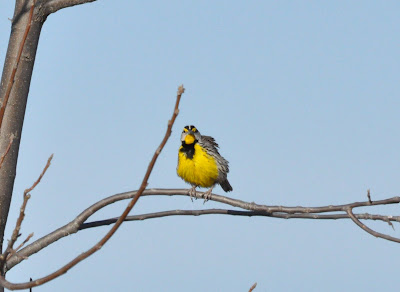
What a wonderful drive home from work today. The beautiful sunny weather must have given some birds that extra little push they were waiting for because I saw my first male eastern bluebird of the year and two eastern meadowlark. I was listening to music quitely and I had my sunroof open as I drove down a country road. I first heard one meadowlark calling. What a beautiful melodious sound they make and so recognizable. I quickly pulled over and started looking for it. It didn't take me long without the sound of my stereo and car rumbling down the gravel road. It was perched in a dormant maple tree singing its heart out. They are such a striking yellow and a real refreshing burst of colour to the back road landscape. It then flew over to a pine tree where another was perched. As soon as the one landed the other one took off to another location. I snapped a few pictures before it flew after its friend. The males and females look pretty much identical but I hope they are a mating pair. I didn't have much time so I left but they are close to where a pair nested last year so I hope they are on their way there. Once they get settled in and I have more time to observe, I will go over to visit and maybe bring a house-warming gift. The same goes with the bluebirds. The pictures from today are heavily cropped but they work for now.

Sunday, March 21, 2010

Overcast isn't always bad.

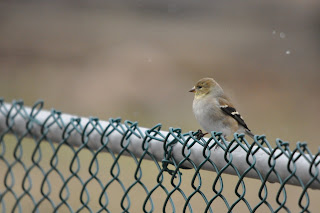
Saturday and Sunday was pretty much overcast the entire time. On Saturday I stayed home and it worked out nicely because we ended up getting an influx of birds to our back yard. We had grackles, juncos, a red-winged blackbird, a downy woodpecker, starlings and goldfinches. On Sunday I went out in the morning thinking it was supposed to clear up a bit. It didn't but I still got to see lots of stuff anyway. Here are some of my shots.


Saturday, March 20, 2010

12 hours, 400 kilometres and $32.00 of gas!

Since the weekend was looking like rain for the most part I thought I would take advantage of the nice weather on Friday. I started my day with a drive up to Minesing Swamp. I made it there for the crack of dawn. I saw lots of waterfowl from the road like hooded mergansers, buffleheads, common goldeneyes, trumpeter swans, mallards, oh and a muskrat. There was also a really nice raft of ring necked ducks but the main reason I was going there was to see the northern pintails. They were way off into a flooded sod field so I took off the canoe from the car and started into the field. I went really slow and tried not to make too much movement with hopes of not scaring them off. I managed to snap off a few shots but they were very timid and kept their distance so no real good shots like what I was hoping for.

On the way home I found a new pond that had a few common mergansers in it. I watched them for a while and then went home. There I removed the canoe, refilled the cooler and took to the roads again. This time I made my way over to the Luther Marsh area and wow spring was in the air. There was a lot of new wildlife this weekend such as a killdeer, a groundhog, a beaver, robins and grackles but most exciting for me was the return of the northern harriers. I spotted one male and one female in the same areas as last year. I really love watching these guys. I think the harriers and coyotes are at the top of my list so far. I watched the female hunt over a field for a while and then all of a sudden she banks quickly and then dropped to the ground. She then lifted up with a pile of dry grasses in her talons. She dropped down in a different location and then started to pick at the grass, maybe she missed because she left right after that.

I have also marked where a few nests are and I have been checking frequently and waiting to see what moves in and today I saw a red-tailed hawk sitting in one of those nests. Maybe some baby hawk pictures this year.

I can't wait for next weekend to see what else is new.


Tuesday, March 16, 2010

Polar bears are currently NOT on Canada's species at risk list.

Here is a copy of the e-mail I sent to the minister of Environment.

To: minister@ec.gc.ca
Subject: Please add the polar bears to Canada's species at risk list

To: Jim Prentice - Minister of the Environment

I just received some information the other day stating that the deadline to add animals to Canada's official species at risk list ends on March 19th/2010. It has been brought to my attention that despite the rapid decline of polar bears within Canada it still seems to not be on the species at risk list. The polar bears current population is estimated around 22,000 - 27,000. Most of this population is situated with Canada, estimated at 15,500 polar bears. It just takes a simple Google search to see page after page indicating the concern for this animal and its habitat. It is so obvious especially after seeing the lack of snow fall this winter that the temperatures are continuing to climb which in turn means fewer hunting grounds for this animal. I realize that you are probably very busy so I will keep this short.

Please add the polar bears to Canada's official species at risk list. The sooner we start protecting this animal the sooner we can take this animal back off the list. The longer we wait the harder and more expensive it will be to return their population back to healthy and sustainable levels.

Thank you
Scott Smith


Monday, March 15, 2010

Reunited and it feels so good.

Well I picked up the camera on Friday and it is amazing. The 4.5 frames per second is just amazing. I also noticed a huge difference in the cameras ability to take pictures in low lighting conditions too. It has a much better built in light sensor and it also has the ability to go much higher on the ISO. I tried a couple shots out and it went to ISO 3200 but kept the shutter speed fast so the pictures turned out quite nice. I also played around with the movie option a bit. It takes really clear movies however the focus is a little weird. You focus on your subject with autofocus but then as soon as you start recording it switches to manual focus. It will take me a little bit to get used to using the manual focus ring while recording.

I just had to get out to try my new camera even though it rained most of the weekend so on Saturday I went for a drive. The first thing I noticed was how much snow was gone. The fields where filled with water and rapidly emptying into the swollen rivers. The culverts where struggling to keep up. It was quickly apparent that most of the snow buntings were gone and now the horned larks are setting up territory and singing their lovely spring sounding tune. I still did manage to find a flock of snow buntings but it was much further north. I checked where I saw the mink last weekend but I found a muskrat instead. I sat and watched it for a while as it foraged for food and the sun actually made an appearance for a bit.

On Sunday it was rainy as well but on my way home I stumbled across a small lake that only had a very small portion of open water and it was filled with ducks. The majority of them were mergansers both common and hooded. I don’t often see the males from both types and I very much enjoyed seeing and watching them as they fished and fought over the females. It was very neat to find a new place and see ducks that I don’t usually get to see. I can’t wait to go back when the lighting is more accommodating for better pictures.

Anyway, I am very glad to be back.
Stay tuned because spring is here and I have a camera again!!